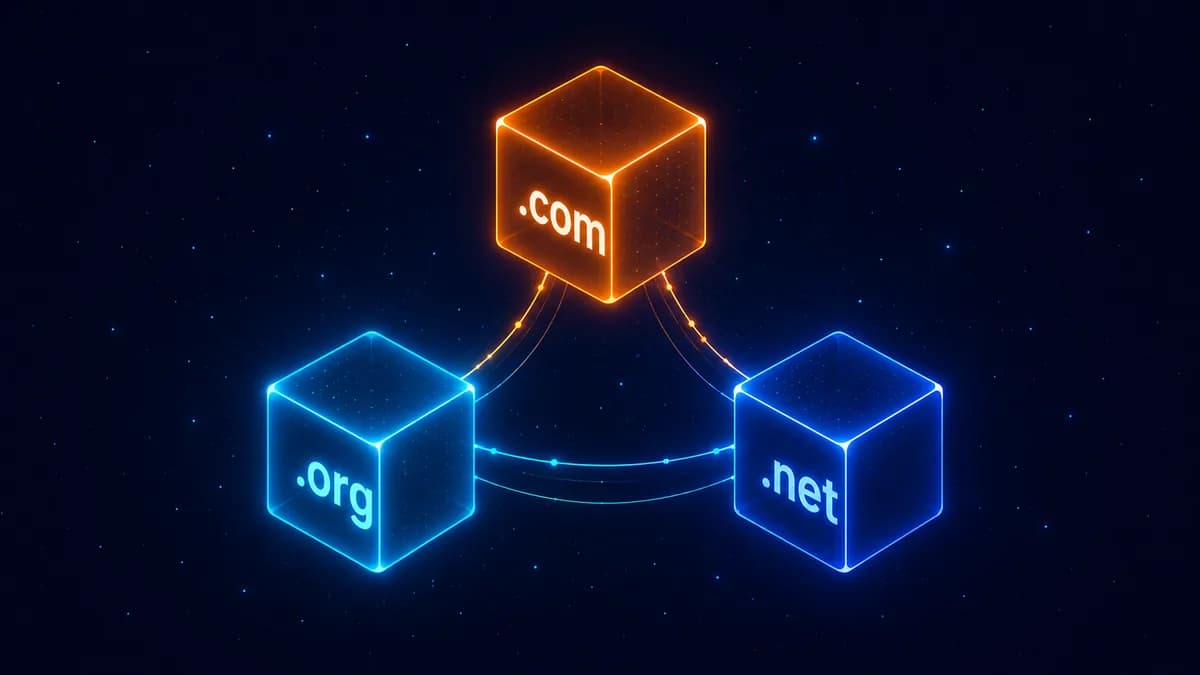
The shortest version of this comparison: .com is the default, .org if you're a community/nonprofit, .net only if your brand is about networks or developer infrastructure. Everything else is overthinking.
What each TLD originally meant
When the DNS was designed in 1985:
- .com — commercial entities (businesses)
- .org — organizations (nonprofits, communities)
- .net — network providers (ISPs, infrastructure)
- .edu — educational institutions
- .gov — US government
- .mil — US military
The first three were "open" from day one — anyone could register, no verification. .edu/.gov/.mil were and still are restricted.
Forty years later, .com / .org / .net are all open, but the original signals stuck. Visitors carry the associations whether or not they think about it.
The brand signals each one sends
.com signals: commercial, professional, default
Visitors expect a .com to be a business — selling a product, offering a service, building toward revenue. .com is also the muscle-memory default; type any random word in the address bar and the browser auto-completes ".com".
Right for: SaaS, e-commerce, agencies, restaurants, professional services, startups, personal brands that double as freelance vehicles.
Wrong for: purely informational/community sites where commercial intent feels off.
.org signals: community, nonprofit, neutral
Visitors expect a .org to be either a nonprofit, an open-source project, a documentation hub, or a community. The TLD reads "we're not selling you something."
Right for: registered nonprofits, foundations, open-source projects (Wikipedia, Apache, Mozilla all use .org), advocacy groups, hobbyist communities, neutral reference sites.
Wrong for: any commercial business — visitors will be confused or distrust your motives. Even legit B2B SaaS using .org reads as slightly off.
.net signals: infrastructure, technical, "for techies"
Visitors expect a .net to be plumbing — a network service, a developer tool, an infrastructure provider. Sourceforge.net, slashdot.org-type tradition.
Right for: ISPs, hosting companies, CDNs, monitoring services, dev infrastructure, peer-to-peer protocols.
Wrong for: anything consumer-facing. Visitors type .com first and end up at a competitor.
Pricing across 5 years (REXO HOST)
| Year 1 | Renewal | 5-year | |
|---|---|---|---|
| .com | ₹399 | ₹399 | ₹1,995 |
| .org | ₹499 | ₹499 | ₹2,495 |
| .net | ₹399 | ₹399 | ₹1,995 |
Difference between the cheapest and most expensive over 5 years: ₹500 total. Don't pick on price.
Real-world examples
.com fits:
- Stripe.com (payments)
- Notion.com (productivity)
- Vercel.com (hosting)
- Acme.com (your future startup)
.org fits:
- Wikipedia.org (encyclopedia)
- Apache.org (open-source software)
- Mozilla.org (foundation)
- LocalAnimalRescue.org (nonprofit)
.net fits:
- Slashdot.org... wait, they're .org despite being a tech community
- SourceForge.net (open-source repository)
- Speedtest.net (network testing)
- Cloudflare.net (their reseller-API site, not the main one)
The pattern: even tech communities pick .org over .net when the project feels community-owned. .net is mostly for the infrastructure layer beneath the community.
When you can't get the .com
This is the most common case. acme.com is taken. Now what?
Better than picking .org or .net:
- Different SLD with .com (
getacme.com,acmeapp.com) - Same SLD with .io (if you're a developer tool)
- Hyphenated .com (last resort —
acme-app.com) - Brand rename if you can stomach it
Picking .org or .net for a commercial brand fights muscle memory forever. Visitors type .com out of habit and you lose them to whoever owns it.
Exceptions: if your brand naturally fits .org (community-led, open-source, nonprofit), picking .org IS better than a contorted .com. Wikipedia would be worse as Wikipediahq.com.
Frequently asked questions
Does Google rank .com higher than .org or .net?
No. Google has stated repeatedly that gTLDs (.com, .org, .net, .info, etc.) carry equal SEO weight. Country codes (.in, .us, .uk) get geo-targeting hints. Pick on brand fit, not search ranking.
Should I register all three for brand defense?
If your brand is generic enough that a competitor or squatter might grab the unused TLD, yes. ~₹1,300/year at REXO HOST for all three. Set one as canonical, 301-redirect the others.
Can I switch from .org to .com later?
Technically yes — but you'll lose backlinks, lose search-ranking history, and have to redirect every visitor who remembered the old URL. It's painful. Pick once, stick with it.
What about new TLDs like .app, .dev, .io?
Solid choices for tech brands but more expensive (~₹2,500-₹4,500/year) and less recognized by non-tech audiences. If you're targeting developers specifically, .io / .dev / .app work well. Otherwise default to .com.
Search and compare
Check .com / .org / .net availability in one search — REXO HOST shows all three side-by-side with prices. No upsells.
Keep reading
Annual vs Multi-Year Domain Registration — Does It Save Money?
When locking in 5 or 10 years of domain registration is worth it, and when annual renewal is the smarter choice.

Cloudflare Nameservers vs Registrar Nameservers — Which to Use?
When to keep DNS at your registrar, when to move it to Cloudflare, and how to do either without breaking your site.

WHOIS Privacy: Free vs Paid — What's the Real Difference?
What WHOIS privacy actually does, when paid versions add value, and why most registrars charging for it are stuck in 2014.