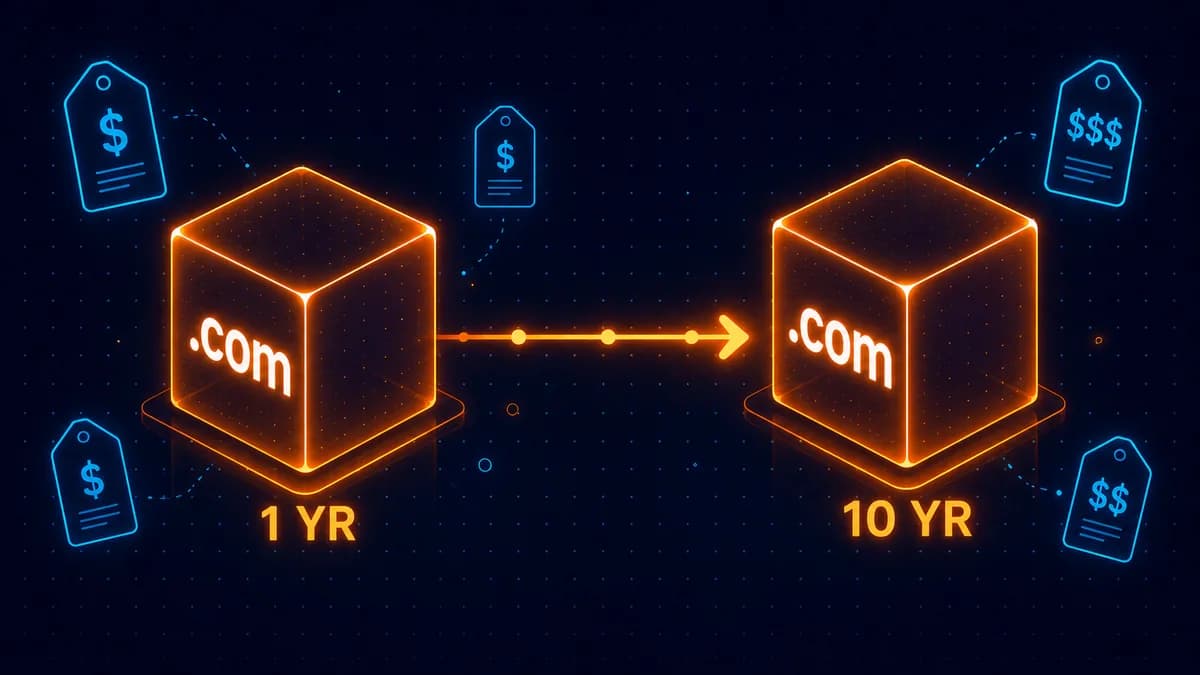
Multi-year registration in 2026 mostly insures you against future registry price hikes, not against your registrar's markup. Whether it's worth it depends on the TLD, the stakes, and how confident you are the project will still exist in 10 years.
What "multi-year" actually means
When you register a domain, you can pay for 1 to 10 years upfront (some TLDs cap at 5). The registry locks the wholesale price for those years — they can't raise it on you mid-term. Your registrar collects the multi-year payment and hands the registry their share annually.
The catch: your registrar's markup applies year-by-year. So a "10-year registration" at REXO HOST is really 10 × the annual price (₹3,990 for .com). Some registrars discount slightly for multi-year (1-3% off); most don't.
The Verisign price-hike timeline
Verisign (.com / .net registry) is the biggest reason to consider multi-year locks. Their ICANN contract allows them to raise wholesale .com prices by 7% per year for four years out of every six. They use this allowance every time:
| Year | .com wholesale | .com retail at REXO HOST |
|---|---|---|
| 2020 | $7.85 | ₹999 (industry avg) |
| 2022 | $8.39 | ₹999-₹1,099 |
| 2024 | $9.59 | ₹1,099-₹1,299 |
| 2026 | $10.26 | ₹399-₹1,499 (huge spread) |
| 2028 (projected) | ~$11 | ? |
A 10-year .com lock at 2026 prices saves you the cumulative effect of those hikes. Approximate math: 7%/year compounded over 10 years = roughly 30-40% savings vs renewing annually at then-current prices.
When multi-year IS worth it
High-stakes brand domains
If your domain is your business name (acmecorp.com), losing it would be catastrophic. Multi-year removes the risk of a missed renewal email, a card expiring, or a registrar going under (you'd transfer the domain to another registrar; the registration period stays).
Long-term projects with stable funding
If your nonprofit or open-source project has a 5-10 year horizon and a budget for it, locking in 10 years removes one operational task forever. Saves staff time more than money.
.com domains specifically
The 7%/year wholesale hikes compound. A .com renewed at REXO HOST is locked-in at ₹399 for the full multi-year term. If we ever need to raise pricing (we will, eventually), you're insulated.
Multi-year as part of a sale/transfer
If you're selling a domain on a marketplace, having "9 years of registration left" is a sales advantage — buyers don't have to think about renewals.
When annual IS the smarter choice
Speculative or side-project domains
You bought weekendidea.com thinking you might launch a side hustle. You probably won't. Pay annually; if you don't renew, you're out ₹399, not ₹3,990.
Personal projects with uncertain longevity
Blog you might abandon, learning project, portfolio site you'll outgrow. Pay annually until you're sure.
When you might want to switch TLDs
Locked into 10 years of acme.org and now you wish you'd registered acme.com? You can't get those 10 years of payment back. Annual gives flexibility.
Cash-flow-constrained startups
₹3,990 once vs ₹399 × 10 years is the same total but different cash flow. If launching is tight, pay annually and reinvest the freed cash.
Real pricing math at REXO HOST
| TLD | 1 year | 5 years | 10 years | "Discount" |
|---|---|---|---|---|
| .com | ₹399 | ₹1,995 | ₹3,990 | None — flat per-year rate |
| .org | ₹499 | ₹2,495 | ₹4,990 | None |
| .net | ₹399 | ₹1,995 | ₹3,990 | None |
| .us | ₹349 | ₹1,745 | (max 10 yrs) ₹3,490 | None |
We don't bait-and-switch with multi-year discounts because our 1-year price is already at the wholesale floor. Some registrars discount multi-year by ~₹100 total, which is barely material.
Frequently asked questions
What if I want to cancel a multi-year registration mid-term?
ICANN's 5-day grace period applies to all new registrations. After that, you're committed to the full term. You can transfer the domain to another registrar (transferring keeps the remaining term) but you can't get a refund.
Can I extend a domain mid-registration?
Yes — at any time, you can pay for additional years on top of what you have. Adds them to your existing expiry. We support this in your dashboard under Renew.
What happens if I forget to renew a 10-year registration?
After 10 years (when the term expires), the same expiry → grace → redemption → public-availability cycle applies as a 1-year registration. You'd still get expiry warning emails 60-30-7 days before. Full timeline.
Does multi-year affect SEO?
Marginally. Google's algorithms consider domain age + registration length as one weak signal of legitimacy. A 10-year registration on a 5-year-old domain looks more credible than a 1-year registration. The effect is small but non-zero.
What about premium / aftermarket domains?
Some premium domains (high-value names) require multi-year minimum at registration. Their pricing is set by the seller, not the registry. Always read the fine print.
Lock in today's price
Search at REXO HOST — pick 1 to 10 years at checkout. Same per-year rate either way; the multi-year benefit is purely insurance against future registry hikes.
Keep reading

Cloudflare Nameservers vs Registrar Nameservers — Which to Use?
When to keep DNS at your registrar, when to move it to Cloudflare, and how to do either without breaking your site.

WHOIS Privacy: Free vs Paid — What's the Real Difference?
What WHOIS privacy actually does, when paid versions add value, and why most registrars charging for it are stuck in 2014.

.com vs .org vs .net — When to Pick Which
The brand signals each TLD sends, the audiences that expect each one, and the cost difference across 5 years.